
Policy for securing cargo
Safe securing of cargo on board
Color Line is committed to safety. Our policy for securing movable cargo units on board our vessels is in accordance with the Maritime Administrations’ rules and regulations.
Cargo securing requirements
A cargo lashing manual has been developed for each of our vessels, based on its trade. The manual has been verified by relevant authorities and describes the safe transportation and securing of freight on board our vessels. To fulfil these requirements, it is of utmost importance that all freight units loaded on board have the correct number of approved lashing brackets.
All customers must comply with the following cargo securing requirements:
1. Approved lashing brackets
Freight units must be equipped with approved safety lashing brackets in accordance with the IMO Code of Safe Practice for Cargo Stowage and Securing, as well as ISO 9367-1 / 9367-2. Each freight unit must have at least four (4) approved lashing brackets on each side. Further information on standard requirements can be found at: www.standard.no and www.iso.org.
2. Flexibility of lashing brackets
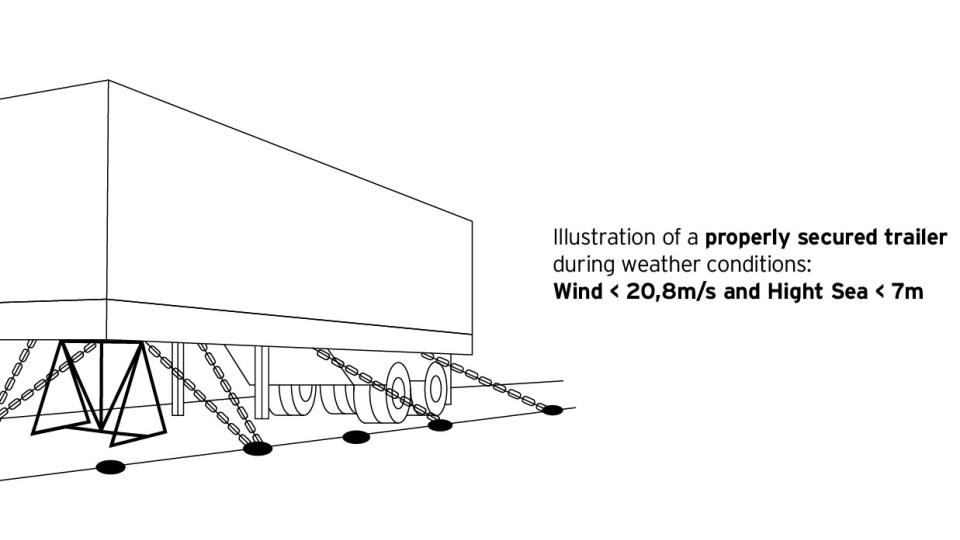
Each lashing bracket shall enable the crew to secure the unit to the deck at different angles, as illustrated below. Depending on the weather forecast, the number of lashings required may vary, typically ranging from 0 to 16.
3. Support of trailers
Trailers should not be supported on their landing legs during sea transport.
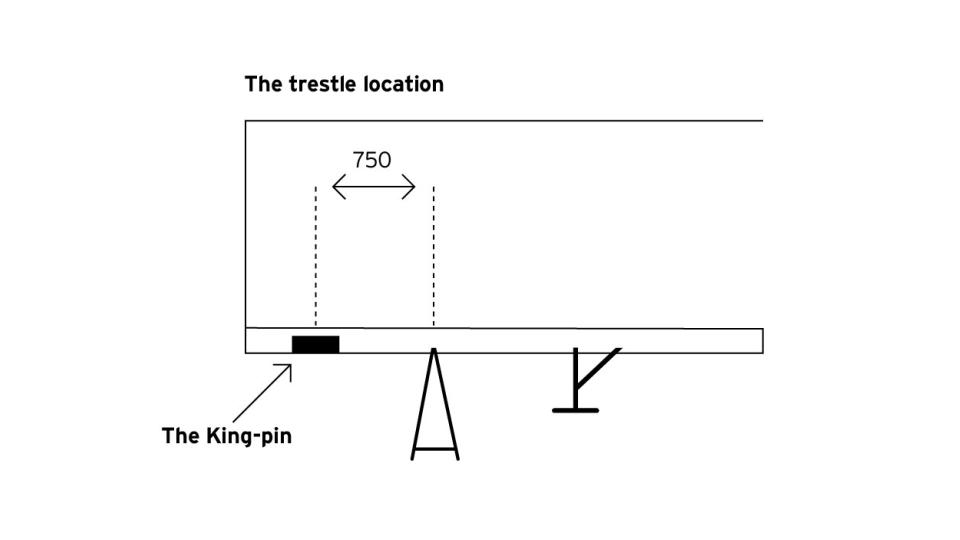
Uncoupled trailers must be supported by a trestle or a similar device. There must be markings on both sides of the trailer indicating where the trestle should be placed.
4. Cargo inside containers
Cargo transported in containers must be secured in accordance with the IMO Code of Safe Practice for Cargo Stowage and Securing. Random compliance checks may be carried out prior to loading. Freight units that do not comply with the code will be rejected.
5. Special transport cargo
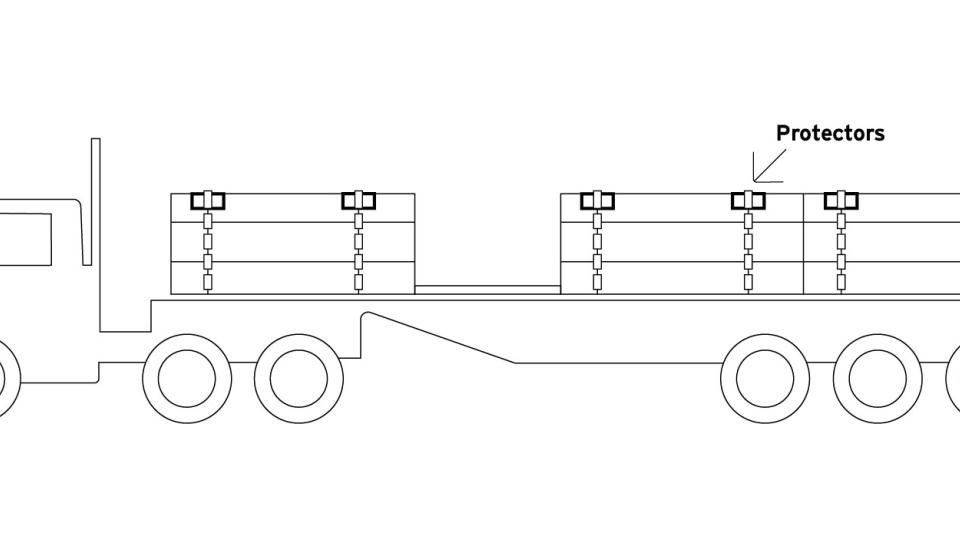
Cargo defined as special transport requiring lashing should preferably be secured with chains, in accordance with applicable provisions for proper load protection described in the IMDG Code (IMO MSC A.714 (17)).
6. Use of lashing straps (exception)
The Master of the vessel may accept cargo secured with lashing straps, provided the following requirements are met:
- Correct number of lashings according to cargo measurements
- No visible damage to any lashing equipment
- All lashings are properly tightened
- Dunnage is placed between elements
- Lashing protection is applied over all edges
Right to refuse cargo
The Master of the vessel has both the right and the obligation to refuse shipment of freight units that do not comply with these requirements.
Cargo securing principles
Proper cargo securing is essential for safe transport at sea. The illustrations below show the recommended methods for securing cargo on trailers and other transport units.
The illustration shows a properly secured trailer under defined weather conditions, with wind speeds exceeding 20.8 m/s and wave heights exceeding 7 metres.